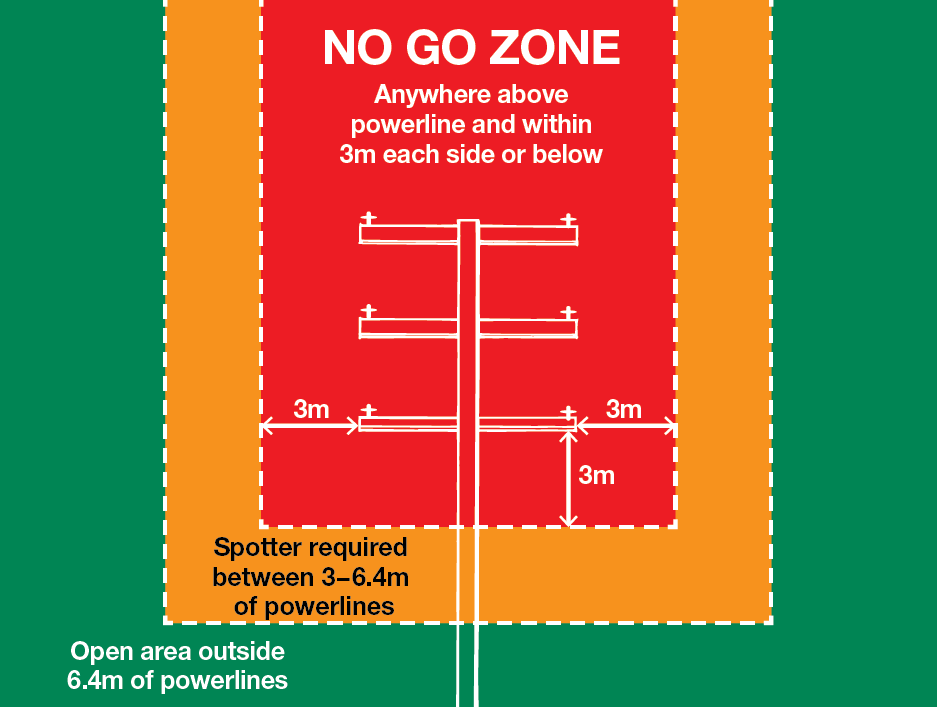
The Electricity Safety (General) Regulations 2019 prescribe the minimum distances people and the vehicles they are using may approach powerlines. The ‘No Go Zone’ rules (figure 1 refers) provide a consistent set of safety requirements for working near powerlines to avoid people or machinery getting too close to powerlines.
It is also an offence under these regulations to fell a tree that may fall within prescribed distances of powerlines without proper qualifications.
Energy Safe Victoria recommends the following best-practice safety information for forestry workers and contractors working near powerlines.
When planning a plantation
Planting distance from powerlines
Trees should be planted at an appropriate distance from powerlines to minimise the risk of injury or death, fire and damage. The risk of an incident occurring increases the closer trees are to powerlines.
We recommend trees are set back at least 2 mature tree lengths from powerlines to minimise the risk to workers. The recommended set back distance also minimises the likelihood of trees falling onto the lines, reducing the risk of groundfires.
Develop a site map with clearly marked powerlines
Powerlines should be clearly marked on a site map in accordance with the Code of Practice for Timber Production 2014. We recommend that all onsite workers are briefed to the location of powerlines before commencing any work activities and have the site map readily available.
Consider installing visual markers to identify powerline locations on easements and roads passing under or near powerlines to remind workers of their locations (for example, signage).
Timber Harvesting Plans
The Code of Practice for Timber Production 2014 requires a Timber Harvesting Plan to be prepared and submitted to the relevant authority before harvesting.
Where powerlines are present on a plantation, we recommend the plan:
- identifies the work areas that are within 2 mature tree heights of any powerline
- identifies any No Go Zones within the work area including control measures developed in consultation with the powerline owner
- describes any permit-to-work system being implemented, including conditions developed in consultation with the powerline owner
- identifies powerlines near easements, roadways, landings and loading areas
- outlines methods for eliminating the risk of trees contacting powerlines and how these trees will be removed to manage this risk
- specifies the site’s electrical emergency management procedure, including the contact details of the powerline owner.
When felling trees
Brief workers of the location of powerlines
We recommend all workers are briefed on the location of powerlines before work commences and have access to the site map. If visual markers identifying powerline locations are used, workers should understand what the markers mean.
All workers should understand and comply with any No Go Zone permit-to-work conditions for the site.
If electrical spotters are being used, machinery operators must be briefed on the role of the spotter and ensure they comply with the spotters’ directions.
Felling work must adapt to changing environmental conditions. During windy or hot conditions, powerlines can sag close to the ground, or sway by up to 3 metres or more to the side. It is important to make sure plantation workers, particularly machinery operators, regularly monitor for changing environmental conditions.
Tree and weather conditions
Before felling, trees should be inspected for signs of damage, disease or structural faults that may cause a tree to fall or break in an unpredicted direction.
Examples of things to look for include trees with splits, multiple stems, structural defects, cavities, decay, or hung-up branches or stems. These trees should be removed in a manner that minimises risks and in accordance with the methods identified in the Timber Harvesting Plan.
Avoid felling trees where high winds may cause the tree to fall unpredictably.
Flammable materials
Never store or stockpile flammable material under powerlines.
Machinery operators
Machinery should only be operated according to the manufacturer’s specifications by people with suitable training and experience in operating the machine.
Operators of machinery should:
- hold appropriate authorisation to operate the machinery they are using
- ensure they understand their personal skill limit as well as machinery limits
- understand the No Go Zone rules when operating machinery near overhead powerlines – if electrical spotters are being used, operators must follow any directions given by the spotter
- consider including appropriate warnings in the cab (for example, No Go Zone stickers), and the use of proximity alarms or warning devices.
Tree felling is a high-risk activity where machinery stability is a key factor that must be considered. Operators of machinery should be aware of their specified machine capabilities. If the size or lean of the tree or terrain is beyond the machine’s capability, it should be felled using alternative methods.
What to do if a powerline is struck
Always treat fallen powerlines as being live as you can be harmed by a fallen powerline without physically touching it.
If a powerline is struck by a fallen tree or you’re in a machine that contacts a powerline (or is close enough to a powerline where electricity has jumped to the machine), remain calm and stay in the cabin and call for help if safe to do so.
Immediately contact:
- 000
- the company that owns the powerlines
- your supervisor/manager.
Remaining in the cabin of the machine will generally be the safest place to be until help arrives; however, if it is not safe to stay in the cabin, for example, in the case of a fire, take the following actions:
Jump clear of the machine, keeping legs and feet close together.
- Land with both feet on the ground at the same time.
- Never touch the machine and the ground at the same time.
- Shuffle away from the machine with both feet staying close together to a minimum distance of 10 metres.
- Once you are more than 10 metres away, do not return to the machine or approach the powerline.
Related information
Date: 28/10/2026 5:05
The currency and accuracy of this information cannot be guaranteed once printed or saved to a storage device. If in doubt, please check the Energy Safe Victoria website for the current version.
Reviewed