The Electricity Safety (General) Regulations 2019 require BESSs to be installed in accordance with AS/NZS 5139:2019 Electrical installations - Safety of battery systems for use with power conversion equipment. Clauses 4.2.4 and 5.2.4 set out the requirements for the protection against the spread of fire for pre-assembled integrated BESS and pre-assembled battery systems.
On this webpage, BESS refers to both an integrated battery energy storage system (covered by section 4 of AS/NZS 5139:2019) and pre-assembled battery system (covered by section 5 of AS/NZS 5139:2019).
What is a non-combustible surface or barrier?
In AS/NZS 5139:2019, a non-combustible surface or barrier is a material that has been tested to make sure it will protect against the spread of fire, in accordance with AS 1530.1:2024 Methods for fire tests on building materials, components and structures. This surface or barrier must extend in a zone:
- 600 mm beyond the vertical sides of the BESS
- 900 mm above the BESS, and
- to the bottom of the BESS.
Any hole or vent within this barrier zone greater than 5 mm must be sealed with a fire-retardant sealant.
The following materials are exempt from testing and deemed suitably non-combustible:
- brick or masonry block
- concrete
- compressed cement sheeting, and
- ceramic or terracotta tiles.
Where an exempt material is used, it should have a minimum thickness of 6 mm.
When is a non-combustible barrier required?
Clauses 4.2.4.2 or 5.2.4.2 require a non-combustible barrier to be installed between a BESS and wall when:
- the BESS is installed within 300 mm of a wall that has a habitable room on the other side, and
- the wall is not made of a suitably non-combustible material.
A habitable room is a room associated with a domestic or residential electrical installation used for normal living activities. For example:
- bedroom
- living, lounge or family room
- kitchen or dining room
- office or study.
Can the non-combustible barrier be on the inside face of the habitable room wall?
No. A barrier located on the inside face of a habitable room does not comply with AS/NZS 5139:2019. The non-combustible barrier must be installed between the BESS and the wall, where the wall is not made of a suitable non-combustible material.
The purpose of the non-combustible barrier between the BESS and the wall is to help prevent a fire from the BESS spreading to the building. It does this by slowing or restricting the fire to the small area around the battery system. Without a barrier, a fire involving the BESS could more easily spread to the rest of the house.
Can I install a smaller non-combustible barrier by installing the BESS near the corner of the wall with a habitable room on the other side?
No. Installing a BESS at the corner of a building does not remove the requirements in clauses 4.2.4.2 or 5.2.4.2 for non-combustible materials. It also does not change the requirements for clearances from exits (doors) or windows in clauses 4.2.2.2 or 5.2.2.2.
The non-combustible barrier must extend 600 mm from each side of the BESS installation around the corner of the building. It must also extend from the bottom of the BESS to 900 mm above the BESS. Any hole or vent within this barrier zone greater than 5 mm must be sealed with a fire-retardant sealant.
Figures 1 and 2 – non-combustible barriers on a corner of a building

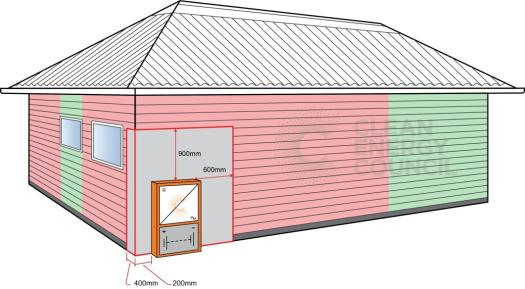
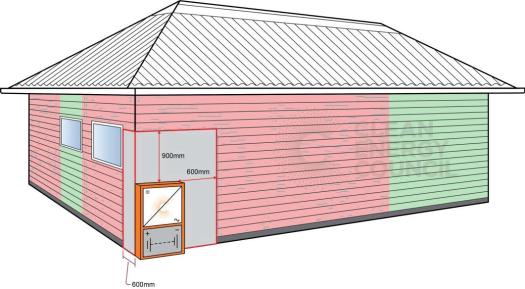
Images copyright of the Clean Energy Council; published with permission.
Can I install a BESS in a garage that is below a habitable room?
Yes. A BESS may be installed in a garage below a habitable room if all of the following requirements are met:
- The BESS is not located in any restricted zones as specified in clauses 4.2.2.2 and 5.2.2.2 (see our BESS clearance requirements guidance for more information)
- The BESS has been installed to maintain the minimum clearances requirements specified by the manufacturer.
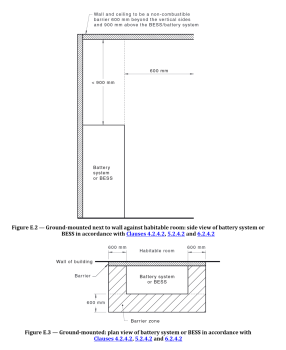
If the BESS is installed against a wall that adjoins a habitable room (either behind, beside or above), a non-combustible barrier must be installed in accordance with clauses 4.2.4.2 and 5.2.4.2. The barrier must extend:
- 600 mm beyond the vertical sides of the BESS
- 900 mm above the BESS, and
- to the bottom of the BESS.
- If the top of the BESS is within 900 mm of the ceiling or structure above the BESS, the ceiling or structure surface shall be suitably non-combustible for an area of 600 mm beyond the outer edges of the BESS.
Figure 3 – Figures E.2 and E.3 of AS/NZS 5139:2019
Can a recessed switchboard/fixed window form part of the non-combustible barrier?
If a switchboard or window forms part of the non-combustible zone, it must be made of a material that has been deemed not combustible when tested in accordance with AS 1530.1.
AS/NZS 5139:2019 requires the non-combustible barrier to be made of material that:
- has been deemed not combustible when tested in accordance with AS 1530.1, or
- AS/NZS 5139:2019 exempts from this requirement.
All material forming the non-combustible barrier zone must meet this requirement.
Figure 4 – Example of a switchboard in a non-combustible zone (not to scale)
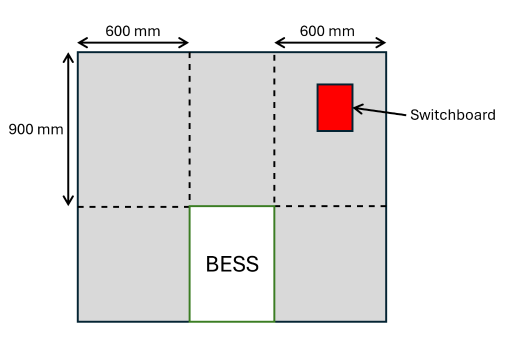
Scenario 1 – the switchboard is recessed into the wall
In this scenario the switchboard is recessed into the wall and forms part of the non-combustible barrier. For this to comply with AS/NZS 5139:2019, the material enclosing the switchboard must be made of a material deemed not combustible when tested in accordance with AS 1530.1.
Any gaps or vents greater than 5 mm in diameter must be sealed with a fire-retardant sealant.
Scenario 2 – the switchboard is surface mounted
In this scenario the switchboard is surface mounted to a brick wall. The installer would need to ensure that any openings through the rear of the switchboard which penetrates the non-combustible barrier are suitably sealed with fire-retardant sealant.
Can a surface mounted switchboard in a standard metal enclosure be within the non-combustible barrier zone?
If a switchboard is surface mounted to a non-combustible material (for example, a brick wall) within an area that must be non-combustible, the installer would need to ensure that any openings greater than 5 mm, through the rear of the switchboard which penetrates the non-combustible barrier (in this case the brick wall) are suitably sealed with fire-retardant sealant.
Is a manufacturer’s statement that their switchboard enclosure material is non-combustible and meets AS 1530.1 sufficient evidence for compliance?
A letter or declaration from a manufacturer may be acceptable evidence of a material being suitably non-combustible. The letter or declaration must:
- state the material has been tested in accordance with AS 1530.1, and
- contain (or reference) a test report conforming to AS 1530.1 as evidence of suitability.
A letter or statement from a manufacturer claiming the material is non-combustible that does not include evidence of testing to meet AS 1530.1 is not acceptable to determine a material’s suitability.
Attribution
All excerpts of AS/NZS 5139:2019 have been reproduced without modifications by Energy Safe Victoria with the permission of Standards Australia Limited.
Copyright in AS/NZS 5139:2019 vests in Standards Australia and Standards New Zealand. Users must not copy or reuse this work without the permission of Standards Australia or the copyright owner.
Disclaimer
The information in this publication is for general guidance only. It does not constitute legal or other professional advice and does not replace any obligations under the Electricity Safety Act 1998 or associated regulations.
You should obtain professional advice about your legal obligations. Energy Safe has made reasonable efforts to provide current and accurate information, but does not make any guarantees regarding the accuracy, currency or completeness of the information.
Date: 17/11/2026 19:45
The currency and accuracy of this information cannot be guaranteed once printed or saved to a storage device. If in doubt, please check the Energy Safe Victoria website for the current version.
Reviewed